I Wanted to Talk About Cool Stuff… But First, socat#
Today I really wanted to jump into more advanced topics, but I realised I first need to address something fundamental.
TCP connections are actually very simple.
Think of them like a phone call:
- You dial → connect
- You talk and listen
- You hang up
Applications basically do the same thing: they open a socket and just read/write data. Everything else (handshakes, retransmissions, congestion control) is handled by the kernel.
But what if we could treat a network connection exactly like a Unix pipe?
That’s where socat comes in.
socat = cat Over the Network#
socat (short for SOcket CAT) lets you create bidirectional byte streams between almost anything: TCP, UDP, files, serial ports, etc.
Simple File Copy Over TCP#
On the receiving side (remotehost):
socat TCP-LISTEN:12345,fork,reuseaddr - > file2On the sending side (localhost):
cat file1 | socat - TCP:remotehost:12345That’s it. You just copied a file over the network as easily as cat file1 > file2.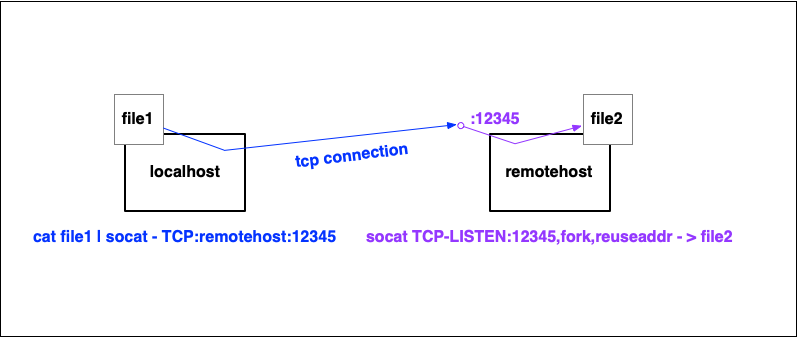
More Advanced: UDP → TCP Proxy#
On the receiving side (remotehost) - that’s the same as previous:
socat TCP-LISTEN:12345,fork,reuseaddr - > file2On the proxy (middleman):
socat -u UDP-LISTEN:54321,fork TCP:remotehost:12345And finally on the sending side (localhost):
cat file1 | socat -u - UDP:proxy:54321That’s it - we just sent the file over UDP and TCP glued together by the TCP-to-UDP proxy.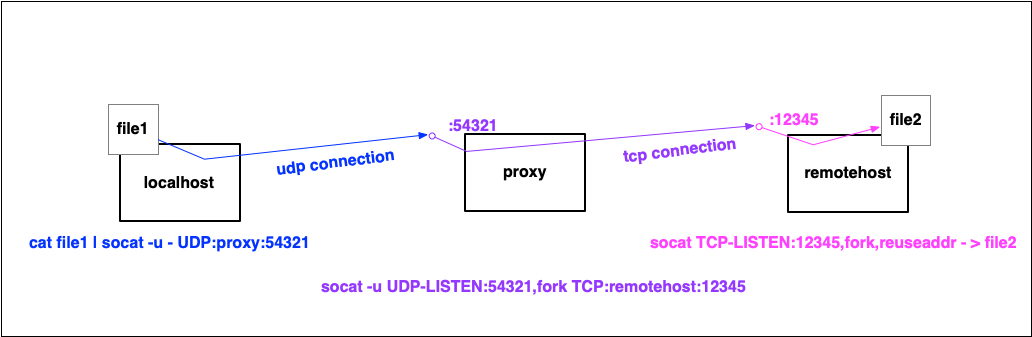
Real-World Example: SSH Over UDP#
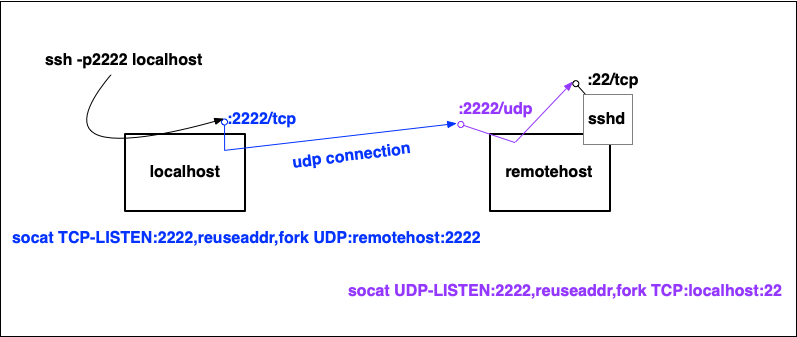
# On remotehost (forward UDP 2222 → local SSH)
socat UDP-LISTEN:2222,reuseaddr,fork TCP:localhost:22

# On localhost (forward local TCP 2222 → remote UDP)
socat TCP-LISTEN:2222,reuseaddr,fork UDP:remotehost:2222
and then just:
ssh -p2222 localhost!SSH OVER UDP! 🎉#
Why This Matters#
socat proves that at the end of the day, most network communication is just streams of bytes. Once you understand that, you can:
- Forward ports creatively
- Build quick proxies and tunnels
- Debug tricky connectivity issues
- Create powerful one-liners
It really is the Swiss Army knife of networking.
Many other official examples: http://www.dest-unreach.org/socat/doc/socat.html#EXAMPLES
I’ll be showing more advanced socat use cases in future posts (port forwarding, TLS tunnels, relay chains, etc.).